The rash on the elderly patient's neck grew larger and more pruritic before they finally sought medical attention at the hospital.
As it turns out, the elderly man initially had a small patch of erythema on his neck that was slightly itchy. At first, he didn't take it seriously and just scratched it, but he found that the more he scratched, the itchier it became. Since he happened to have some Mometasone Furoate at home that was used for his grandson's eczema, he applied it to his neck. Initially, it provided some relief from the itching, but after using it for a week, the rash on his neck not only failed to subside but grew larger and itchier. Because he was busy looking after his grandson and felt that the Mometasone Furoate still offered some degree of antipruritic effect, he refused to come to the hospital despite his wife's urging. It wasn't until a month later, when the rash had grown so large and itchy that it began to interfere with his sleep, that he was forced to seek medical attention.
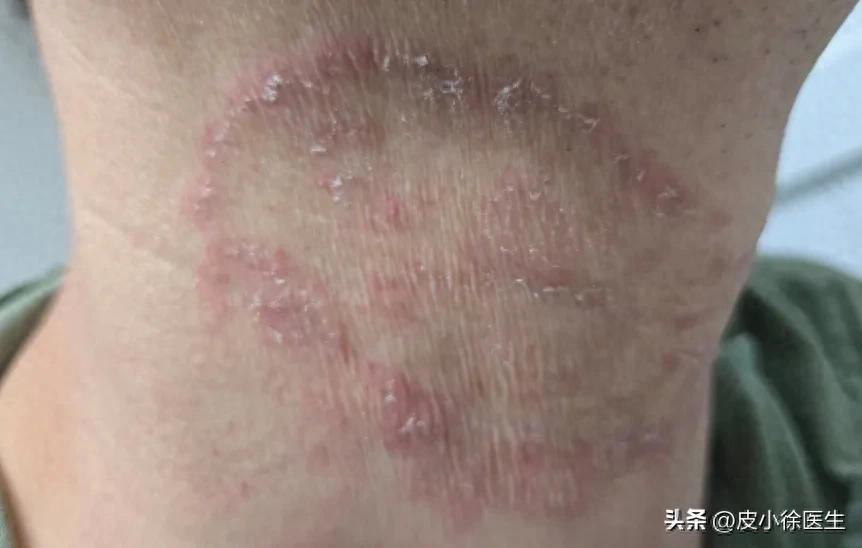
Upon examination, I saw a large area of annular erythema with desquamation and papules inside; this is a very typical case of tinea corporis, which is caused by a fungal infection. I asked, "Do you have tinea pedis (athlete's foot)?" The man replied that he did. I then asked, "Do you scratch your neck after scratching your feet?" He said, "Occasionally, but doctor, please take a look—I have it on my inner thighs too." When the man lowered his trousers, there were large areas of well-demarcated erythema on both sides of his inner thighs. This was clearly tinea cruris caused by a fungal infection. The truth finally came to light: the man had scratched the tinea cruris and subsequently scratched his neck, thereby transmitting the fungi from his groin to his neck. He should have used antifungal medication, but he used the wrong treatment—a corticosteroid ointment. This was equivalent to applying fertilizer to the rash, causing it to become increasingly larger and itchier.

After I informed the elderly patient of the results, it finally dawned on him. I told him not to worry, as the condition is completely curable. I prescribed oral Itraconazole, an antifungal medication, for two weeks, along with topical Ciclopirox Olamine cream for two to four weeks to treat his tinea cruris and the tinea corporis on his neck. I am confident he will recover soon. At the same time, I cautioned him that while ointments are effective and can relieve itching, different causes require different medications; using the wrong medication may lead to the opposite of the desired effect.
When you suffer from skin diseases, do you also use medications indiscriminately like this elderly man? I recommend not using ointments blindly; seeking timely medical consultation is key.