This ancient prescription is highly effective for treating benign prostatic hyperplasia, and those who have used it speak highly of its results.
Prostatic hypertrophy (hyperplasia) is a common disease among middle-aged and elderly men. Due to the enlargement of the prostate, which compresses the urethra, it can cause difficulty in urination, eventually leading to urethral obstruction and resulting in urinary retention, causing significant distress to middle-aged and elderly patients.
The main characteristics of its symptoms can be broadly categorized into the following three types.
Storage Phase Symptoms: Mainly manifest as urinary urgency, increased frequency (especially nocturia), and even urge incontinence, where urine may involuntarily leak upon hearing the sound of running water or due to other reflex triggers.
Voiding Phase Symptoms: Primarily characterized by difficulty in urination. As symptoms worsen, this may progress to hesitancy, a thinning or splitting of the urine stream, sometimes an intermittent or dribbling flow, and occasionally a bifurcated stream. It may take half a minute to a minute to initiate urination. Precipitating factors such as weather changes, fatigue, alcohol consumption, sexual activity, or infection can easily lead to urinary retention, or even complete inability to pass urine.
Other Symptoms: If prostatic hypertrophy develops around the urethra, symptoms may be mild or even absent. If it develops towards the bladder neck, severe symptoms can occur even with minimal enlargement. These may include hematuria, urinary tract infections, bladder stones, and hydronephrosis.
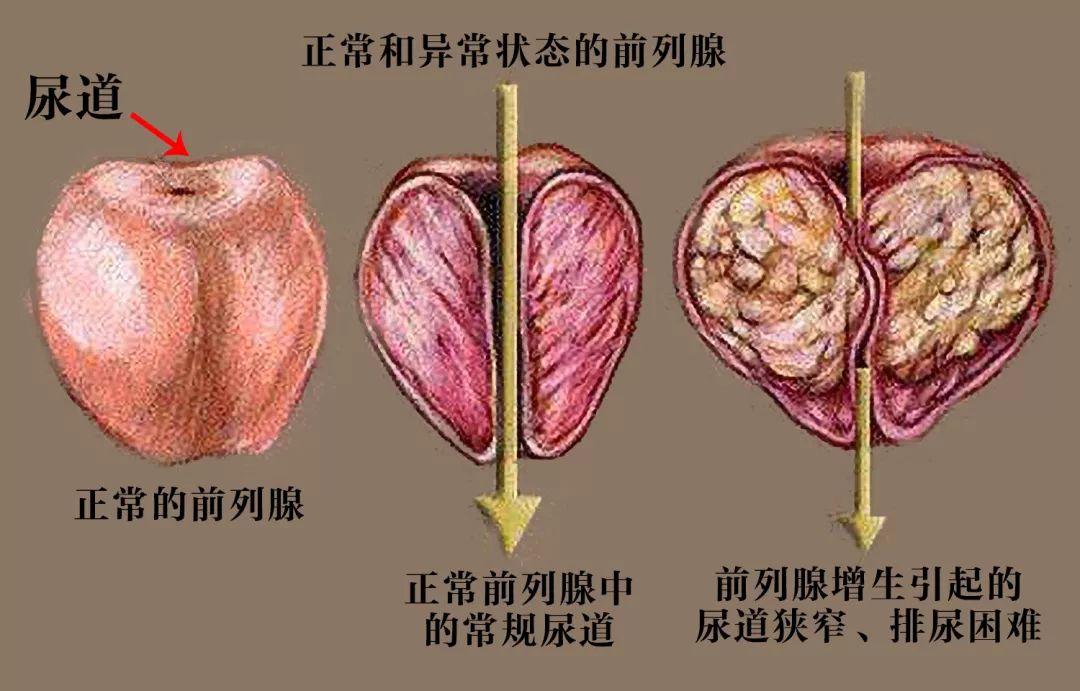
In Traditional Chinese Medicine (TCM), this disease falls under the category of "Bi" (blockage or obstruction). Clinically, with main symptoms such as frequent urination, difficulty urinating, a thin or split urine stream, and dribbling, it belongs to the category of "deficiency syndrome." However, from another perspective, the localized glandular hyperplasia, presenting as a mass obstructing the urethra, clearly indicates a tangible sign, similar to the TCM categories of "Zheng Jia" or "Ji Ju," which are considered excess syndromes. Therefore, this condition is characterized by a root deficiency and a branch excess.
The root deficiency primarily involves kidney qi deficiency, leading to impaired propulsion and transformation, resulting in the obstruction of the urethra by damp-heat, stasis, turbidity, and stagnant essence.
The branch excess refers to the localized glandular hyperplasia, the formation of a mass obstructing the urethra, manifesting as difficult urination or even urinary retention, and lower abdominal distension. This ultimately leads to the obstruction of the urethra by damp-heat, stasis, turbidity, and stagnant essence.
The following formula is a new application of an ancient prescription. It has been clinically validated by numerous physicians and experts and has shown good efficacy even for severe cases.
According to TCM pattern differentiation, this disease involves kidney qi deficiency, internal accumulation of damp-heat, blood stasis congelation, and urethral obstruction. The treatment principle is to tonify kidney qi, resolve toxins and promote diuresis to eliminate dampness, transform stasis and dissipate nodules, and promote urination.
【Formula Composition】Honeysuckle Flower (Jin Yin Hua), Dahurian Angelica Root (Bai Zhi), Chinese Angelica (Dang Gui), Red Peony Root (Chi Shao), Licorice Root (Gan Cao), Zhejiang Fritillaria Bulb (Zhe Bei Mu), Frankincense (Ru Xiang), Myrrh (Mo Yao), Cowherb Seed (Wang Bu Liu Xing), Chinese Honeylocust Spine (Zao Jiao Ci), Trichosanthes Root (Tian Hua Fen), Cyathula Root (Chuan Niu Xi), Amber (Hu Po), Astragalus Root (Huang Qi), Cinnamon Bark (Rou Gui), Plantain Seed (Che Qian Zi), etc.
【Indications】Urinary Blockage (prostatic hyperplasia), accompanied by symptoms such as frequent urination, difficulty urinating, dribbling urination, interrupted urine flow or even drop-by-drop urination, lower abdominal distension, obesity, listlessness, soreness and weakness of the lower back and knees, dry mouth with slight bitterness, purplish-dark tongue with stasis spots, thin yellow tongue coating, etc.
【Formula Explanation】In the formula, Honeysuckle Flower, with its sweet and cold nature, clears heat, resolves toxins, and treats sores.
Frankincense, Myrrh, Chinese Angelica, Red Peony Root, and Tangerine Peel promote qi and blood circulation, unblock collaterals, reduce swelling, and alleviate pain. Combined with Dahurian Angelica Root and Saposhnikovia Root, they unblock stagnation, dissipate nodules, and allow heat toxins to be expelled outward.
Fritillaria Bulb and Trichosanthes Root clear heat, resolve phlegm, and dissipate nodules, dispersing pus that has not yet formed. Cowherb Seed and Chinese Honeylocust Spine unblock the meridians and collaterals, promote pus discharge and ulceration, facilitating the rupture of formed pus.
Licorice Root clears heat and resolves toxins, and harmonizes the effects of the other herbs.
Astragalus Root tonifies qi and raises yang; when qi rises, water naturally descends. Cinnamon Bark assists the fire of the life gate, invigorating bladder qi transformation.
Plantain Seed removes dampness and promotes diuresis. Cyathula Root and Amber enhance the power of activating blood circulation and resolving stasis.
When all herbs are used together, they replenish qi and yang, unblock stasis to circulate throughout the body, assist the medicinal power in reaching the affected area directly, resolve toxins and dissipate stasis, unblock the urethra, and thereby eliminate all symptoms.